Electronic Monitoring of Migrants
Across the USA, every day, hundreds of thousands of migrants are tracked through a global positioning (GPS) device strapped to their ankle or through a cellphone with the SmartLINK application.
This deployment of for-profit surveillance technology creates a parallel system to the tens of thousands of detention beds that make the USA the country with the largest immigrant detention population in the world.
The videos were made in collaboration with asylum seekers who have chosen to speak out about their experiences of digital detention – not to improve their personal situation, but in the hope that no other person will have to go through the same hardships in the future.
The SmartLINK application sends notifications at various times of the day and night ordering asylum seekers to take and submit a photo of themselves.
“I am monitored through SmartLINK on my personal phone. The app has a calendar function, and I expected it to give me information about my court date, but I never got any. At every check-in I would always ask the officer about my court-date, I was so anxious that I might miss it. Then one day the ICE officer told me that I had missed my court date and that I was going to be deported.”. – Lorena, asylum seeker from Guatemala.
Electronic monitoring programs are not true alternatives to detention. They are a for-profit expansion of detention, managed by one of the world’s largest prison corporations, that imposes a significant financial cost on US taxpayers and a considerable human toll on migrants, their family members and larger community.
Asma’s Story
Asma came to the U.S. with her husband and three children seeking protection from religious persecution in Pakistan. While ICE detained her husband, Asma was placed on an ankle monitor and released with her children. The ankle monitor scared her youngest child, and her two oldest children felt great shame about being with their mother in public. Asma struggled to find employment to provide for herself and her children. A food-truck owner finally gave her a job because, he told her, the customers could not see the monitor if she stayed behind the counter in the truck. However, one day at work, her ankle monitor started blaring because it was low on battery. Her employer fired her. ICE removed the monitor after 10 months without any explanation, even though Asma’s final asylum hearing in Immigration Court took place several years later. A year after the ankle monitor was removed, Asma still experienced phantom buzzing in her leg and sleep deprivation. Today, she is still embarrassed by the visible white scars left on her ankle by the chafing and overheating ankle monitor. Asma and her family members all received asylum in Immigration Court and have now been approved for their green cards. They question why they were subjected to monitoring when their asylum claims were valid all along.

The use of electronic monitoring was initially deployed in the criminal legal system, affording certain pre-trial and sentenced persons the opportunity to remain in or return to the community. In 1977 Jack Love, an Albuquerque judge, read a Spiderman comic where the superhero was being tracked by a transmitter which his nemesis, the Kingpin, had strapped on his wrist. The judge convinced a computer company, Behavioral Intervensions Inc. to develop a similar device. BI is now owned by GEO group, one of the world’s largest for-profit companies, and electronic monitoring has spread in criminal justice systems worldwide since the early 1980s. Electronic monitoring was adopted in the immigration context in 2004 and quickly morphed from an alternative to an expansion of detention. While electronic monitoring was adopted from the criminal context, no one in the custody of either ICE or CBP is facing criminal charges or serving a criminal sentence; their detention is related only to their civil immigration proceedings.
Ravi’s Story
A permanent legal resident since 1994, Ravi Ragbir was detained and ordered deported in 2006 based on a conviction for fraud. After being detained in New Jersey and Alabama, Ravi was one of the first immigrants in the New York metropolitan area to be released with an ankle monitor under the ISAP program in 2008. Initially, he was happy to be reunited with his family and community, but being monitored soon felt like a “prison without walls, but a much harsher prison.” He adds, “The walls close in upon you. It was very difficult to be employed and to support myself, because of the constant check-ins, and my movements were limited within the five boroughs of New York City, where I was surveilled constantly through the GPS enabled ankle monitor. When my wife and I got married, we were looking for a place to eat, driving on the highway. I didn’t know we had crossed the border to another county. But the GPS did and the ankle monitor said: ‘You are exiting your master zone! You are exiting your master zone.’ My foot started talking to me! It turned out we had changed counties. Afterwards, for three days, I lived under the guillotine that they will take me back in, that you have violated a border. The so-called alternative is much more tortuous, it takes control of your life.”
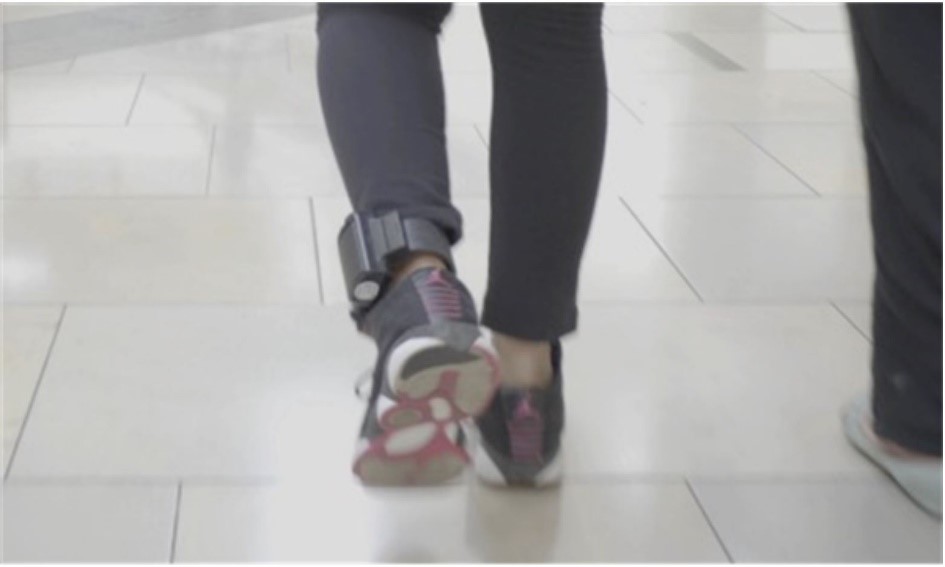
Lilia’s story
“When you’re in immigration detention, you are just desperate to get out. Put three grillette on me, just let me out! But once you are outside, things get complicated.” Lilia, an asylum seeker in Austin, Texas, looks down on the big black plastic box strapped tightly to her thin ankle. Grillette means ‘ankle shackle’ and is commonly used by Spanish-speakers to describe electronic ankle monitors. Lilia explains how the grillette made her feel oppressed, as though she were still in detention, or rather, incarcerated “como encarcerada”, using the terms “immigration detention” and “prison” indistinctively, as many immigrants do, adding: “I think that through my grillette, ICE follows where I and other asylum seekers go – so that they know where undocumented migrants meet and congregate. That way, they can arrest more undocumented migrants.”
On 19 August 2019, ICE conducted the largest immigration raid in recent US history, arresting 680 workers at a poultry manufacturing plant, detaining and deporting hundreds of couples, leaving their children to come home from school to empty houses. The Mississippi raids marked a new era of immigration enforcement with the active participation of Silicon Valley tech giant Palantir and the use of data harvested from digital monitoring of asylum seekers for the preparation of the raids. The affidavit of the arrest revealed how hundreds of migrants were arrested by extracting surveillance data over time from the electronic monitors of three women from Central America who had found work at the plant, one of them having worn an electronic ankle monitor for five years, another having been ‘de-escalated’ to facial recognition app SmartLINK® in February 2019.
Electronic monitoring is also an expansion of supervision, because it often lasts much longer than does detention. The average amount of time spent under electronic monitoring hovered around 550 days as of September 2023. The average amount of time spent in detention is much less at an average 37.4 days in 2023, although it bears noting that this data is skewed by ICE’s inclusion of brief periods of detention preceding rapid removals.
Besides becoming one’s own jailer – being responsible for charging the devices that confine them – migrants experience a specific temporal experience marked by high degrees of uncertainty. They do not know if they will be released from their electronic monitoring device today, tomorrow, in a month or a year, and whether this release marks the day where they will obtain asylum, legalization or be deported.
Spaces and technologies may change, but whether migrants are detained or monitored through an electronic ankle monitor or through their smartphones, whether their mobility is reduced to a prison ward, to a detention center, to a county or to a state, the temporal uncertainty and their deportability remains a defining characteristic of their experience of confinement.
Read more in the American Bar Association Commission on Immigration report: Electronic Monitoring of Migrants: Punitive not Prudent (2024) https://www.americanbar.org/content/dam/aba/administrative/immigration/electronic-monitoring-report-2024-02-21.pdf
C. Boe. (2023) Expanding Penal Landscapes into Immigrant Communities: Digital ‘Alternatives’ to Detention in the USA . https://blogs.law.ox.ac.uk/border-criminologies-blog/blog-post/2023/03/expanding-penal-landscapes-immigrant-communities
Carolina S. Boe (2020) “Fighting Border Control in Three Sites of Confinement: Contestation and Visibility in Prison, Immigration Detention and Under Digital Confinement in New York”, Champ pénal/Penal field 20 | 2020 http://journals.openedition.org/champpenal/12273
Boe, C. S. and Henry Mainsah: “Detained through a Smartphone: Deploying Experimental Collaborative Visual Methods to Study the Socio-Technical Landscape of Digital Confinement” December 2021 Digital Culture & Society 7(2):287-310 https://www.academia.edu/108975887/Detained_through_a_Smartphone_Deploying_Experimental_Collaborative_Visual_Methods_to_Study_the_Socio_Technical_Landscape_of_Digital_Confinement?uc-sb-sw=685138
Videos produced with generous funding from Independent Research Fund Denmark, Carlsbergfondet and Wenner Gren Foundation.
 Carolina Sanchez Boe